

I Use 4 Notebooks to Run My Entire Life
In a world of apps and notifications, the most powerful productivity tool is paper


I run my entire life on four paper notebooks.
No productivity apps.
No task managers.
No note-taking software syncing across seven devices.
Just four physical journals sitting on my desk.
People think I'm insane.
We're in 2024.
Everything is supposed to be digital, cloud-synced, accessible everywhere.
But that's exactly the problem.
Digital tools are fucking noisy.
Every app wants your attention.
Your task manager sends notifications.
Your note-taking app suggests features.
Your calendar buzzes.
Your phone pings.
Research shows people toggle between apps about 1,200 times daily, losing four hours per week just switching between tools.
Your brain never settles.
I tried every productivity system.
Notion.
Todoist.
Obsidian.
Clickup.
Apple Notes.
Google Keep.
Each one promised to be the system that would finally organize my life.
Each one became another place where ideas went to die.
Why Paper Works When Apps Fail
Writing by hand forces you to think slower.
That sounds like a disadvantage.
It's not.
When you type, your fingers move faster than your thoughts.
You're transcribing, not thinking.
Research from the Norwegian University of Science and Technology found that handwriting activates more brain regions than typing.
Particularly in areas responsible for memory formation and sensory processing.
The fine motor control required to form letters creates stronger neural pathways.
Your brain pays attention when you write.
When you type, you're on autopilot.
There's also something about permanence.
Digital notes feel disposable.
You can delete them, edit them, move them between folders.
They're weightless.
Handwritten notes feel real.
Once the pen hits paper, the thought exists in physical space.
You can flip back through pages and see your thinking evolve over weeks and months.
You can't search handwritten notes with Command-F.
That's a feature, not a bug.
You have to engage with your past thinking to find anything.
That re-engagement is where the real value lives.
The Problem With Journaling Without a System
I used to keep one notebook.
I'd write everything in it.
Tasks next to creative ideas next to emotional brain dumps next to meeting notes.
The notebook became chaos.
When I needed to find something, I'd flip through fifty pages of unrelated thoughts.
A journal without structure becomes a graveyard for forgotten ideas.
The solution isn't to stop using notebooks.
It's to give different types of thinking different homes.
That's the four-notebook system.
These are the actual notebooks I use daily.
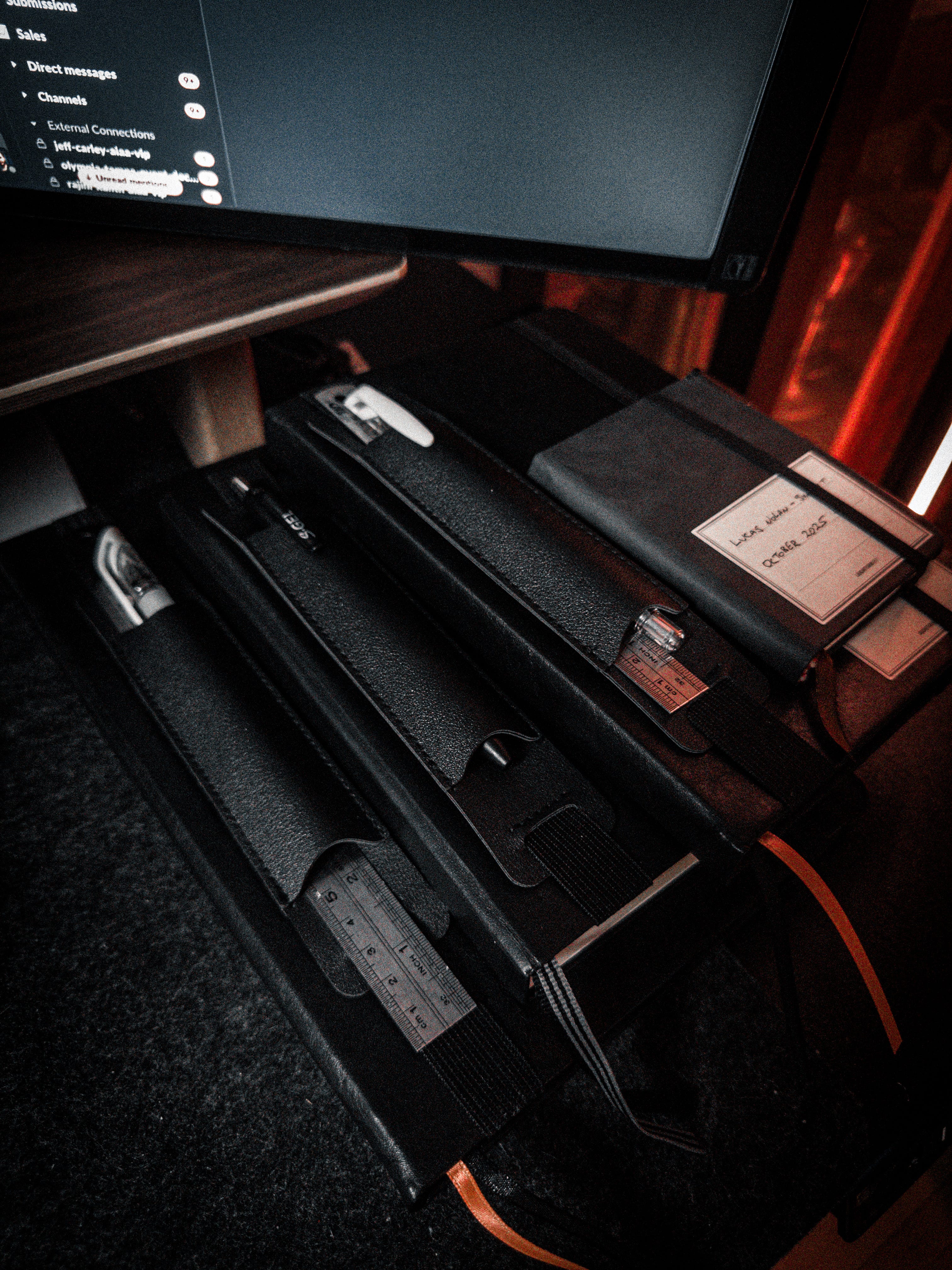
Notebook One - The Capture Log
This is a pocket-sized notebook I carry everywhere.
Its job is simple.
Capture everything before it disappears.
Ideas while watching YouTube.
Tasks that pop into my head during a walk.
Random thoughts in the middle of a conversation.
Anything that feels worth remembering goes into the Capture Log.
No organization.
No categories.
Just raw capture.
The mistake most people make is trying to organize ideas as they capture them.
That's two different types of thinking happening at once.
Capture now, organize later.
Every Sunday, I process the Capture Log.
Tasks go into the Command Log.
Business ideas go into the Creation Log.
Personal reflections go into the Clarity Log.
The Capture Log gets emptied and starts fresh.
Without the Capture Log, ideas evaporate.
You're in the shower and you think of the perfect solution to a problem at work.
By the time you're dressed, it's gone.
Your brain isn't designed to hold onto fleeting thoughts.
It's designed to let them pass.
The Capture Log makes them permanent.
Notebook Two - The Command Log
This is a larger journal.
The daily command center.
Every morning, I open it and write three things:
What I'm working on today
What I need to solve
What I'm avoiding
That last one matters.
Most productivity systems focus on what you should do.
The Command Log forces you to name what you're not doing.
The project you keep pushing back.
The conversation you're avoiding.
The decision you haven't made.
Writing it down doesn't magically fix procrastination.
But it stops you from lying to yourself about why the day felt unproductive.
The Command Log is also where I plan projects.
Not in some elaborate task hierarchy with subtasks and dependencies.
Just simple outlines.
What needs to happen.
What order makes sense.
What I'm doing first.
When the project is done, I draw a line through it.
Physical completion feels better than clicking a checkbox.
At the end of each week, I review the Command Log.
What actually got done.
What didn't.
What patterns keep showing up.
This isn't some productivity guilt trip.
It's information.
You can't improve a system you don't understand.
Notebook Three - The Creation Log
This is a regular-sized journal for future thinking.
Content ideas.
New business concepts.
Random "what if" questions that might turn into something.
The Creation Log is where strategy happens.
Not daily tasks.
Not immediate problems.
The stuff that builds toward something bigger.
Every content piece I publish starts in the Creation Log.
I'll sketch out the structure.
Write down angles I'm considering.
List examples that might work.
Draw terrible diagrams that make sense only to me.
By the time I sit down to actually create, the thinking is already done.
I'm executing, not inventing.
Most people try to plan and execute simultaneously.
That's why they stare at a blank screen for forty minutes.
Separate creation into two phases.
Thinking and building.
The Creation Log handles the first part.
It's also a place for dumb ideas.
Digital notes feel too permanent for dumb ideas.
You write something stupid in Notion and it sits there judging you.
In the Creation Log, dumb ideas live next to good ones.
Some of my best work started as a sentence I almost didn't write because it felt too weird.
Give your dumb ideas a home.
Some of them are smarter than they sound.
Notebook Four - The Clarity Log
This is the personal journal.
The one that keeps me sane.
Some days I'm stressed and I don't know why.
Some days I'm avoiding work and I don't know what I'm actually avoiding.
Some days I'm making a decision and I can't figure out what I actually want.
The Clarity Log is where I write until I understand.
There's no structure here.
No format.
Just brain dumps.
I write what I'm thinking and feeling until the thinking becomes clear.
This isn't gratitude journaling.
I'm not listing three things I'm thankful for.
This isn't morning pages.
I'm not writing three pages of stream-of-consciousness before coffee.
This is problem-solving through writing.
Your thoughts are messy when they're in your head.
Writing forces you to linearize them.
You have to put one word after another.
That process reveals what you actually think.
I've made every major life decision in the Clarity Log.
Career pivots.
Relationship conversations.
Financial choices.
Writing helps me separate what I think I should want from what I actually want.
The Clarity Log isn't daily.
Some weeks I don't touch it.
Other weeks I'm in it every morning.
It's there when I need it.
How the Four Notebooks Work Together
The system works because each notebook has one job.
The Capture Log grabs ideas before they disappear.
The Command Log turns those ideas into action.
The Creation Log builds the future.
The Clarity Log processes everything else.
When everything lives in one place, nothing has space to breathe.
When everything has its own place, you know exactly where to look.
The four notebooks also prevent the trap most productivity systems fall into.
Overcomplication.
You don't need 47 features.
You don't need tags and filters and saved searches.
You need a place to put your thoughts and a reason to return to them.
Paper is simple.
Open the notebook.
Write.
Close it.
Done.
No syncing.
No updates.
No features you'll never use.
Just a pen and a page.
Try One Notebook for One Week
You don't need to adopt all four notebooks immediately.
Start with one.
The Capture Log.
Get a pocket-sized notebook.
This is the one I use, found it on Amazon, comes with a pen.
(It’s literally 4 euro, not an affiliate link)

Carry it for a week.
Every time you have a thought worth keeping, write it down.
Don't organize it.
Don't worry about handwriting.
Just capture.
At the end of the week, flip through it.
You'll be surprised how many ideas you would have lost.
That's the point.
Productivity isn't about doing more.
It's about losing less.
The four-notebook system doesn't make you superhuman.
It makes you less forgetful.
In a world where every app is screaming for your attention.
The quietest tool is the most powerful.
No notifications.
No updates.
No distractions.
Just you and the page.