

My AI Assistant Died and I Fixed It in 10 Minutes
Why owning your infrastructure matters more than the tools you run on it

9:47 AM.
Clawd.Bot stops responding mid-conversation.
Not slow.
Not glitchy.
Just dead.
I refresh.
Nothing.
Check the logs.
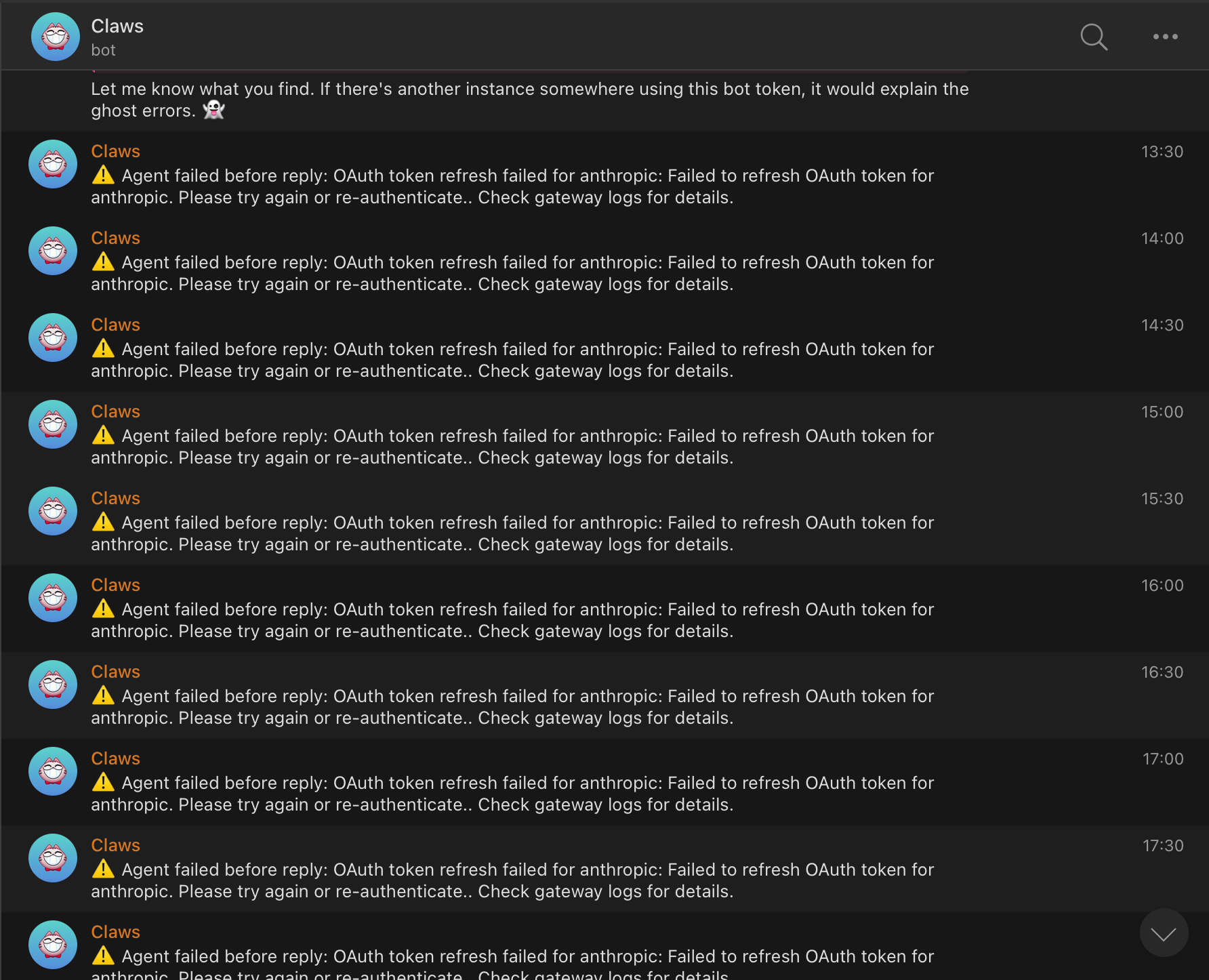
OAuth error.
Anthropic changed something in their configuration, and my entire automation stack - the thing I’ve been building and relying on for months - just flatlined.
Most people would be fucked at this point.
They’d open a support ticket.
Wait for someone else to fix it.
Refresh their email every 20 minutes hoping for an update.
Maybe switch to a different tool entirely and lose days rebuilding workflows.
I was back online in 10 minutes.
Not because I’m some genius.
Not because I got lucky.
Because I own the server it runs on, I understand the system, and I know how to fix it when it breaks.
The System Before the Break
Let me set the scene.
I run Clawd.Bot on my own server.
Not a SaaS subscription.
Not a managed service.
My infrastructure.
My rules.
It’s an AI assistant that handles a bunch of automated workflows - content generation, research pipelines, task routing, the kind of shit that used to take me hours every day.
You can install it yourself here.
It can do some pretty cool stuff, it vibe coded me this Pocket clone entirely from my phone.
For weeks, it just worked.
Then Anthropic pushed an OAuth configuration update.
Nothing dramatic.
Just one of those backend changes that companies make all the time for security or compliance reasons.
The kind of thing that wouldn’t even make it into a changelog.
Except it broke my setup completely.
Here’s what happened technically.
Anthropic changed how their OAuth tokens were validated.
The old tokens were still technically valid, but the authentication middleware was now checking for a different scope configuration.
My server was sending credentials in the old format.
The API rejected them.
Everything downstream stopped.
Single point of failure.
Suddenly my cute AI cat Claws that handles my daily tasks for me stopped working.
According to research from MIT, about 70-85% of organizations using AI tools today rely primarily on SaaS or managed services.
They don’t own the infrastructure.
They don’t control the dependencies.
When something breaks at the vendor level - and it will break - they’re at the mercy of someone else’s timeline.
If you depend on a system you don’t control, you’re gambling that it won’t fail at the worst possible moment.
And when it does fail, your options are limited to whatever the vendor decides to prioritize.
I wasn’t gambling.
I knew exactly where the failure was, and I had the access to fix it.
The Part Where Most People Get Stuck
When the OAuth error hit, I didn’t panic.
I opened my terminal, SSH’d into the server, pulled up the error logs, and saw exactly what was failing.
The authentication layer.
Token validation specifically.
Most people wouldn’t know where to start.
Not because they’re stupid.
Because they never had to learn.
SaaS abstracts all of this away.
You click buttons.
You pay monthly fees.
The system works until it doesn’t, and when it stops working, you have no visibility into why or how to fix it.
That’s the trade-off everyone makes without realizing it.
Convenience for control.
Speed for understanding.
Ease of use for resilience.
I get it.
Most people don’t want to manage servers.
They don’t want to debug OAuth configurations or wrestle with API documentation.
They just want tools that work.
But what they don’t realise is that when the tool breaks, and you don’t own any part of the underlying system, you’re powerless.
You’re waiting on someone else’s engineers to notice the problem, prioritize it, and ship a fix.
Meanwhile, your workflows are dead in the water.
I’ve seen this happen to friends running businesses.
A Zapier integration breaks.
A Notion API change wipes out their entire knowledge base structure.
An Airtable deprecation kills months of automation work.
They scramble.
They rebuild.
They lose days or weeks.
And the worst part?
They can’t prevent it from happening again.
Because they don’t own the system.
They rent access to it.
How I Actually Fixed It
I didn’t fix it alone.
I used Claude.
Specifically, I used Claude Code.
A version of Claude that can connect directly to my server and interact with the codebase.
I gave it access.
Explained the error.
Pointed it at the logs.
It identified the OAuth scope mismatch immediately.
Suggested the fix - switch from oAuth access to direct API token access.
I reviewed the changes.
Deployed them.
Restarted the service.
Clawd.Bot came back online.
Total downtime: less than 10 minutes.
I didn’t fix this because I’m some elite hacker.
I’m not.
I fixed it because I had three things most people don’t:
Direct access to the server and the ability to make changes.
Enough understanding of the system to know where to look and what questions to ask.
The right tools to help me solve the problem quickly once I understood it.
If I’d been using a SaaS tool, I wouldn’t have had any of those.
I wouldn’t have been able to see the logs.
I wouldn’t have been able to modify the authentication layer.
I wouldn’t have been able to deploy a fix.
I’d have been stuck waiting.
The Real Bottleneck Isn’t the Cloud
People love to blame infrastructure when things break.
“The cloud is unreliable.”
“APIs change too much.”
“Vendors don’t care about backwards compatibility.”
All of that is true.
But it’s not the bottleneck.
The bottleneck is knowledge and access.
If you understand how your systems work, you can adapt when things break.
If you have access to the underlying infrastructure, you can fix problems instead of waiting for someone else to care.
The cloud isn’t the problem.
Dependency is.
Centralized dependencies - single OAuth providers, single API endpoints, single orchestration platforms - create cascading failures.
When one piece breaks, everything downstream dies.
This is especially common in AI automation stacks where workflows chain multiple services together.
One broken link kills the entire chain.
The way to avoid this isn’t to avoid the cloud or avoid SaaS tools entirely.
It’s to own the critical pieces.
The parts you can’t afford to break.
The parts where downtime isn’t an option.
For me, that’s the server.
The orchestration logic.
The core automation flows.
I use SaaS tools for everything else.
I use Linear.
I use Slack.
I use a dozen other services.
But I don’t build critical dependencies on things I can’t fix.
That’s the difference.
What Most People Should Actually Do
You don’t need to become a sysadmin.
You don’t need to run your own servers or learn how to debug OAuth flows.
But you should understand the systems you depend on.
At least enough to know where the single points of failure are.
At least enough to have a plan when something breaks.
Ask yourself:
If this tool stopped working right now, could I fix it?
Could I even diagnose what broke?
Or would I just be stuck waiting?
If the answer is “stuck waiting,” you’re more fragile than you think.
Here’s what you can do instead:
Own the critical path. Identify the 2-3 tools or workflows you absolutely cannot function without. Those are the ones worth bringing in-house or at least understanding deeply enough to fix when they break.
Learn the layer below. You don’t need to master everything. But if you’re using a no-code tool, learn a little code. If you’re using an API, read the documentation. If you’re running automations, understand what actually happens when you click the button.
Build redundancy where it matters. Use multiple providers. Have fallback workflows. Don’t put all your critical operations on a single platform that could change or break without warning.
Invest in understanding, not just tools. Tools are cheap. Understanding is expensive. But understanding is what lets you move fast when things break, while everyone else is stuck refreshing their support ticket.
The goal isn’t to do everything yourself.
It’s to never be completely helpless.
The Lesson I Keep Learning
Every time something breaks, I’m reminded of the same truth.
Leverage is great until it disappears.
SaaS tools give you incredible leverage.
Automation gives you incredible leverage.
AI gives you incredible leverage.
But leverage is borrowed power.
And borrowed power can be taken away.
The only real power is the ability to solve your own problems.
When Clawd.Bot went down, I didn’t lose days.
I didn’t scramble to find alternatives.
I didn’t sit around waiting for someone else to care about my problem.
I fixed it.
Quickly.
Because I could.
That’s not about being smart.
It’s about preparation.
It’s about owning the things that matter.
It’s about understanding the systems you depend on well enough that when they break - and they will break - you’re not paralyzed.
Most people won’t do this.
They’ll keep renting access to tools they don’t understand, and they’ll keep getting burned when those tools change or break.
You don’t have to be most people.
You can own your infrastructure.
You can learn how your systems work.
You can build resilience instead of dependency.
Or you can keep hoping nothing ever breaks.
Your call.