

The Retardmaxxing Playbook
How to be so dumb you can't fail


You know what the successful people have in common?
They’re not smarter.
They’re not more talented.
They don’t have better networks or more resources.
They just have a shorter distance between “I should do this” and “I did this.”
That’s it.
That’s the whole game.
While you’re in your head running simulations, they’re in the market running experiments.
While you’re finding reasons it won’t work, they’re finding customers.
While you’re perfecting your positioning, they’re making money with positioning that’s mid at best.
And the gap between you keeps growing.
Not because they’re better.
Because they’re dumber.
Dumb enough to start before they’re ready.
Dumb enough to ship before it’s perfect.
Dumb enough to think they can win when all the smart people are explaining why they can’t.
You know the midwit meme?
This one:
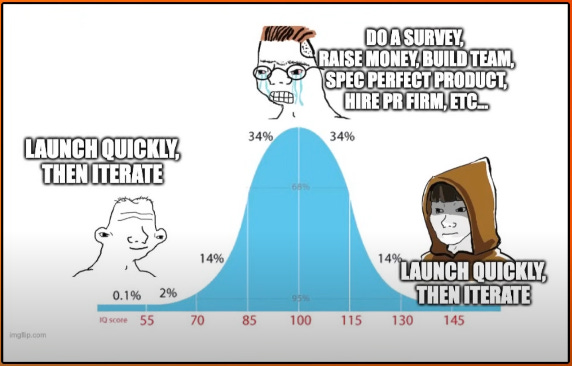
I’m going to show you how to be the guy on the left.
This is the playbook.
The exact system for being so aggressively ignorant of your own limitations that you accidentally build something that works.
Rule 1: Stop Asking Questions You Don’t Need Answered Yet
Questions are intellectual security blankets.
Every time you ask “but what about...”
You’re really asking “can you give me permission to not do this yet?”
I see it every day.
“Should I niche down or go broad?”
“What CRM should I use?”
“How do I structure my offer if I’m targeting both B2B and B2C?”
“What’s the best time to post on LinkedIn?”
You know what the answer is to all of these?
It doesn’t fucking matter yet.
You have zero clients.
You’re asking questions that matter when you’re doing $50K/month.
You’re at $0.
The only question that matters is: “Did I make an offer today?”
That’s it.
Pick literally any niche. Any CRM. Any structure. Any time.
Make the decision in 30 seconds and move on.
You can change it later when you have data.
Right now you have opinions.
Opinions are worth nothing until they’re tested against reality.
The questions you’re asking are just anxiety wearing a business casual outfit.
Stop asking them.
Start doing the thing you’re afraid to do.
Rule 2: Copy the Template Exactly
There’s a template that works.
Someone spent years testing it.
They’ve run it hundreds of times.
They’ve optimized it.
They’ve removed the parts that don’t work.
They’ve refined the parts that do.
And they’re handing it to you.
Your job is to copy it exactly.
Not customize it.
Not “make it yours.”
Not adapt it to your unique situation.
Copy. It. Exactly.
I’m watching a student right now who’s going to fail.
He’s smart as hell.
Asks incredible questions.
Sees nuances nobody else sees.
And he’s customizing everything.
“I think for my market, I should adjust the outreach to...”
“The landing page template is good but what if I...”
“I’m going to test a different approach because my clients are...”
No.
No no no.
You don’t have enough data to know what needs customizing.
You think your market is special.
It’s not.
You think you’ve identified a flaw in the system.
You haven’t.
You’ve identified your fear of following instructions.
The template works because it’s been de-risked through repetition.
Every time you change it, you’re adding risk back in.
You’re trading a proven system for your untested hypothesis.
Do you know how fucking stupid that is?
Copy the template.
Run it.
Get results.
THEN customize based on actual data instead of imagined problems.
Rule 3: Implement Before You Understand
This one breaks people’s brains.
“But I need to understand WHY it works before I can do it.”
No you don’t.
You need to do it.
Understanding comes from doing.
Not the other way around.
I learned N8N by building broken workflows.
I learned automation by shipping things that didn’t work right.
I learned what makes a good offer by making terrible offers and watching them fail.
You cannot think your way to competence.
You have to build your way there.
But here’s what you’re actually afraid of.
You’re afraid that if you don’t understand it fully, you’ll look stupid when someone asks you a question.
You’re afraid you’ll implement something wrong.
You’re afraid you won’t be able to explain your choices.
Good.
Looking stupid is the admission price for getting smart.
Every expert you admire was completely fucking clueless at one point.
They just didn’t let that stop them from doing the thing.
The developer who built Dropbox’s competitor in his head never built anything.
The founder who built Dropbox without overthinking it built a $10B company.
One person understood everything.
One person did something.
Guess which one matters.
Rule 4: Set a Timer for Decisions
You don’t need more information.
You need less time to think.
Every decision you’re agonizing over has a maximum complexity of 30 seconds.
“Should I reach out to this person?”
30 seconds. Yes or no.
“Should I launch this offer?”
30 seconds. Yes or no.
“Should I post this content?”
30 seconds. Yes or no.
The extra 45 minutes you spend “thinking it through” isn’t making the decision easier.
It’s giving your fear more time to construct rational-sounding objections.
You’re not being thorough.
You’re being scared.
Here’s the system:
See the decision
Start a 30-second timer
Make the decision before it goes off
Immediately take the first action
Don’t revisit it
No exceptions.
No “but this one is more complex.”
If it feels more complex, you’re overthinking it.
Make it simple.
Make it fast.
Make it now.
Execution speed is a competitive advantage that nobody talks about.
While your competitors are in decision paralysis, you’ve already launched, gotten feedback, and iterated.
You’re three versions ahead while they’re still on version zero.
Be so fast you don’t have time to talk yourself out of it.
Rule 5: Treat Failure as Data, Not as Judgment
Here’s why smart people don’t start.
They think failure means they were wrong.
And being wrong means they’re not as smart as they thought.
So they’d rather not try than risk finding out they’re not the genius they’ve convinced themselves they are.
This is the dumbest possible way to look at business.
Failure isn’t a report card on your intelligence.
It’s a feedback loop on your execution.
You built the wrong thing?
Cool, now you know what not to build.
Your offer didn’t convert?
Great, now you have data on what doesn’t resonate.
Your outreach got ignored?
Perfect, now you can test different messaging.
None of this means you’re stupid.
It means you’re learning.
The person who fails 100 times learns 100 things.
The person who fails zero times learns zero things.
Stop protecting your ego.
Start collecting data.
Your intelligence doesn’t matter if you never test it against reality.
Rule 6: Build in Public Before You’re Ready
The smartest people I know hide.
They work on their thing in private.
They refine it.
They perfect it.
They wait until it’s “ready” to show anyone.
Then they launch it and nobody cares.
Because they built something for an audience that doesn’t exist.
The dumbest people I know build in public from day one.
Shitty first draft? Posted.
Half-baked idea? Shared.
Embarrassing early work? Out there.
And guess what happens?
People engage.
People give feedback.
People tell them what they actually want.
And these “dumb” people build exactly what the market is asking for.
While the smart people are still perfecting version 1.0 in private, the dumb people are on version 8.0 because they shipped everything and learned from real feedback.
Your fear of judgment is costing you more than judgment ever could.
Nobody’s watching you as closely as you think.
Nobody cares about your rough drafts.
Everyone’s too busy worrying about their own shit.
Ship the bad version.
Get feedback.
Ship the slightly less bad version.
Repeat until it’s good.
This is the only way it actually works.
Rule 7: Operate on 80% Information
You will never have perfect information.
You will never have complete certainty.
You will never have every question answered.
And you don’t need any of that to start.
If you’re waiting for 100% confidence, you’re waiting forever.
The people who win operate on 80% information.
Sometimes 60%.
Sometimes 40% and a vibe.
They make the call with incomplete data because they know that action generates more information than thinking ever could.
You’re sitting there running mental simulations with made-up variables.
They’re running real experiments with actual outcomes.
Your simulations tell you what might happen.
Their experiments tell them what did happen.
Which one sounds more useful?
Make the decision with the information you have right now.
Not the information you wish you had.
Not the information you could have if you spent another week researching.
The information you have right now, in this moment, is enough.
If it’s not enough, you’ll find out fast.
And that’s fine.
Because finding out fast means you can fix it fast.
Slow decisions are expensive.
Fast decisions are cheap, even when they’re wrong.
Be wrong quickly so you can be right quickly.
Rule 8: Celebrate Speed Over Quality
Here’s a controversial one.
Quality doesn’t matter as much as you think.
Not in the beginning anyway.
In the beginning, speed matters.
Getting reps matters.
Building momentum matters.
You cannot ship your way to quality.
But you absolutely can think your way to mediocrity.
Because while you’re perfecting one thing, your competitor shipped five things.
Four of them sucked.
One of them worked.
And now they’re scaling the one that worked while you’re still polishing your first attempt.
The market doesn’t reward the best work.
It rewards the work that ships.
You think quality is the difference between success and failure.
It’s not.
Shipping is the difference.
Quality comes from iteration.
Iteration comes from shipping.
Shipping comes from being dumb enough to hit publish before you’re ready.
So celebrate the fact that you shipped.
Even if it’s rough.
Even if it’s not your best work.
Even if you cringe looking at it.
You put something in the world.
That’s infinitely better than the perfect thing sitting in your drafts folder.
The Retardmaxxing Scorecard
Here’s how you know if you’re actually doing this:
✅ You shipped something this week you’re slightly embarrassed by
✅ You made a decision in under a minute that you would’ve agonized over for days
✅ You copied someone’s template exactly instead of spending hours tweaking it
✅ You did something without fully understanding why it works
✅ You got feedback on work that wasn’t finished
✅ You took action with incomplete information
✅ You prioritized speed over quality on at least one thing
If you can check off more than 3, you’re on the right track.
If you can’t check off any, you’re still stuck in your head.
And that’s the whole problem.
The Only Question That Matters
Are you going to be the person who knows everything and does nothing?
Or the person who knows enough and does something?
Because I promise you, the person doing something is going to win.
Every single time.
Not because they’re smarter.
Not because they’re more talented.
Not because they have some unfair advantage.
Because they’re dumb enough to try.
Dumb enough to start before they’re ready.
Dumb enough to ship before it’s perfect.
Dumb enough to believe they can figure it out as they go.
So stop thinking.
Start doing.
Be unreasonably optimistic about your chances.
Be selectively ignorant about the obstacles.
Be aggressively biased toward action.
Be so retarded you can’t fail.
Because the only way you actually fail is by never trying at all.
And you’re way too smart for that.
Right?
We have a banger article, bias for execution should be in everyone's operating principles
Learned this the hard way