

Your Automations Are Already Dead
What happens when the system fixes itself without you


I watched someone delete their entire automation stack last Tuesday.
Not because it broke.
Because it couldn’t learn.
Oliver runs an agency managing 23 clients.
Each one requires a 175-step onboarding sequence.
Client check-ins.
Slack updates.
Deliverables.
He’d built the whole thing in N8N.
Beautiful workflows, pristine logic, API calls choreographed like a ballet.
Then Slack changed their API.
Everything stopped.
He spent three days rebuilding.
Two weeks later, another service updated.
More repairs.
He’d become a maintenance worker for his own infrastructure.
That’s when he realized something most people building automation miss.
You’re not building systems that run forever.
You’re building systems that break forever.
The Automation Trap
Traditional automation operates on a simple premise that stopped being true somewhere around 2023.
You map inputs to outputs.
When X happens, do Y.
If A changes, trigger B.
The logic is clean.
The workflows are elegant.
The whole thing feels like progress.
Until reality intervenes.
APIs evolve.
Services deprecate endpoints.
Data structures shift.
What worked last month returns errors this week.
Your beautiful automation becomes a liability that demands constant attention.
The math doesn’t work for agencies.
You build a system once, charge for it once, then maintain it forever.
No recurring revenue from the automation itself.
Just recurring headaches.
This is the one-time build problem, and it’s killing boutique agencies who thought automation would set them free.
Instead, they’re trapped.
They sold efficiency but delivered dependency.
Clients expect things to work.
When they break, someone has to fix them.
That someone is you, at 11pm, debugging webhook failures.
The promise was leverage.
The reality is a different kind of labor.
You’ve just replaced client work with infrastructure work.
Same burnout, different spreadsheet.
When Machines Learn To Heal Themselves
Something shifted in how autonomous systems operate over the last 18 months that most people haven’t noticed yet.
AI agents don’t just execute tasks anymore.
They evaluate outcomes, store what happened, and adjust their approach based on results.
This isn’t traditional automation with extra steps.
It’s a different architecture entirely.
Instead of you writing if-then logic, you write directives.
The system interprets those directives, creates its own execution paths as python scripts, and - this is the critical part - fixes itself when something breaks.
An API changes?
The agent tries the old method, gets an error, references its knowledge base, identifies the new pattern, and adapts.
No human intervention.
No emergency Slack messages.
No 11pm debugging sessions.
This is what people mean when they talk about agentic workflows, though most explanations make it sound more complex than it is.
Three components:
Directive - The knowledge behind WHAT to do.
Orchestration - AI Decision Making
Execution - Doing the actual work, with continuous evaluation.
The system creates a feedback loop.
Every action generates data.
That data informs the next action.
Mistakes become training material instead of fires you have to put out.
Research into autonomous AI systems shows they can reduce maintenance requirements by 85% compared to traditional automation, primarily because they self-correct through reflection and continuous learning rather than breaking when conditions change.
But here’s what makes this practically useful rather than just theoretically interesting.
You’re not building the intelligence from scratch.
You’re giving the agent skill bibles.
Detailed, 5,000-word instruction manuals for every task it might encounter.
How to handle client onboarding.
How to parse Slack data.
How to format deliverables.
How to write VSL funnels.
How to escalate edge cases.
The agent reads the skill bible relevant to its current task, executes based on those instructions, evaluates the outcome, and updates its understanding for next time.
You document the process once.
The system gets better at it forever.
What This Actually Looks Like
Doby runs an AI Automation consultancy business that used to require constant human oversight.
Client communications.
Status updates.
Data synthesis.
The kind of work that’s tedious but too nuanced for traditional automation.
He implemented agentic workflows six months ago.
His observation after the transition captures something important about how this changes the operator experience.
“Clients never want to see the backend. They want outcomes.”
The system handles client check-ins through Slack.
Synthesizes project data.
Sends updates.
Flags issues that need human attention.
Everything else runs autonomously.
What used to require a VA or junior team member now requires occasional directive updates and reviewing the agent’s output summaries.
The actual execution happens without intervention.
Oliver’s agency tells a similar story, but from a different angle.
Twenty-three clients.
Each one generating hundreds of data points weekly.
Client success metrics.
Project milestones.
Communication threads.
Deliverable status.
His agentic system processes all of it.
Not through pre-programmed workflows that break when data structures change, but through agents that evaluate each situation and choose appropriate responses.
The 175-step onboarding sequence doesn’t exist as 175 hardcoded actions anymore.
It exists as a directive — get the client from signed contract to active delivery — and a skill bible documenting best practices for each phase.
The agent handles the rest.
When a client has a unique situation, it adapts.
When a service changes its API, it figures out the new pattern.
When something genuinely requires human judgment, it escalates.
Here’s what makes this economically interesting beyond the obvious time savings.
Both of them run these systems 24/7 on their own computer for free or a $5 /month deployment on Railway.
Not $400.
Four dollars.
The bulk of operational costs comes from LLM API calls - the actual intelligence - which scales with usage but remains predictable.
You can get a Claude Max plan for $200 per month and use it to run your entire agency.
Traditional automation requires expensive integration platforms.
Monthly subscriptions to Make or N8N’s enterprise tiers.
Additional services to handle edge cases.
The cost adds up before you factor in maintenance time.
Modern agentic systems run on basic cloud infrastructure.
The intelligence lives in the models.
The cost structure shifts from fixed platform fees to variable usage that scales with actual value delivered.
You pay for thinking, not for infrastructure.
The Recurring Revenue Problem Nobody Talks About
Agencies face an awkward economic reality with traditional automation.
You sell it once.
You maintain it forever.
The client gets ongoing value.
You get ongoing work without ongoing revenue.
Some agencies try to fix this with retainers.
Monthly fees for maintenance and updates.
It works until the client realizes they’re paying you to keep something working that you promised would work.
The relationship sours.
The retainer feels like a tax.
They start looking for alternatives.
Agentic workflows change the underlying economics in a way that’s not immediately obvious.
Because the system improves over time rather than degrading, and because it handles most maintenance autonomously, your relationship with the client shifts from firefighter to strategist.
You’re not maintaining their infrastructure.
You’re improving their directives.
Identifying new processes to automate.
Training agents on new skills.
Expanding what the system can handle.
That’s consulting work.
Strategy work.
The kind of thing clients happily pay ongoing fees for because they see compounding value.
The automation maintains itself.
You maintain the vision.
This solves the LTV problem that’s been quietly killing automation agencies.
The value you deliver doesn’t decay over time.
It compounds.
The system gets smarter.
The client gets better outcomes.
The relationship has room to grow.
You’re not selling a static product anymore.
You’re selling an adaptive capability.
How This Actually Gets Built
Most agentic workflow systems share a common architecture that’s simpler than it sounds.
You need three things.
An agent framework that can interpret directives and choose actions.
A knowledge base where the agent stores and retrieves information.
A set of skill bibles that document how to approach different tasks.
The framework handles the intelligence.
You can run the whole thing from VSCode or just Claude Code directly in your terminal.
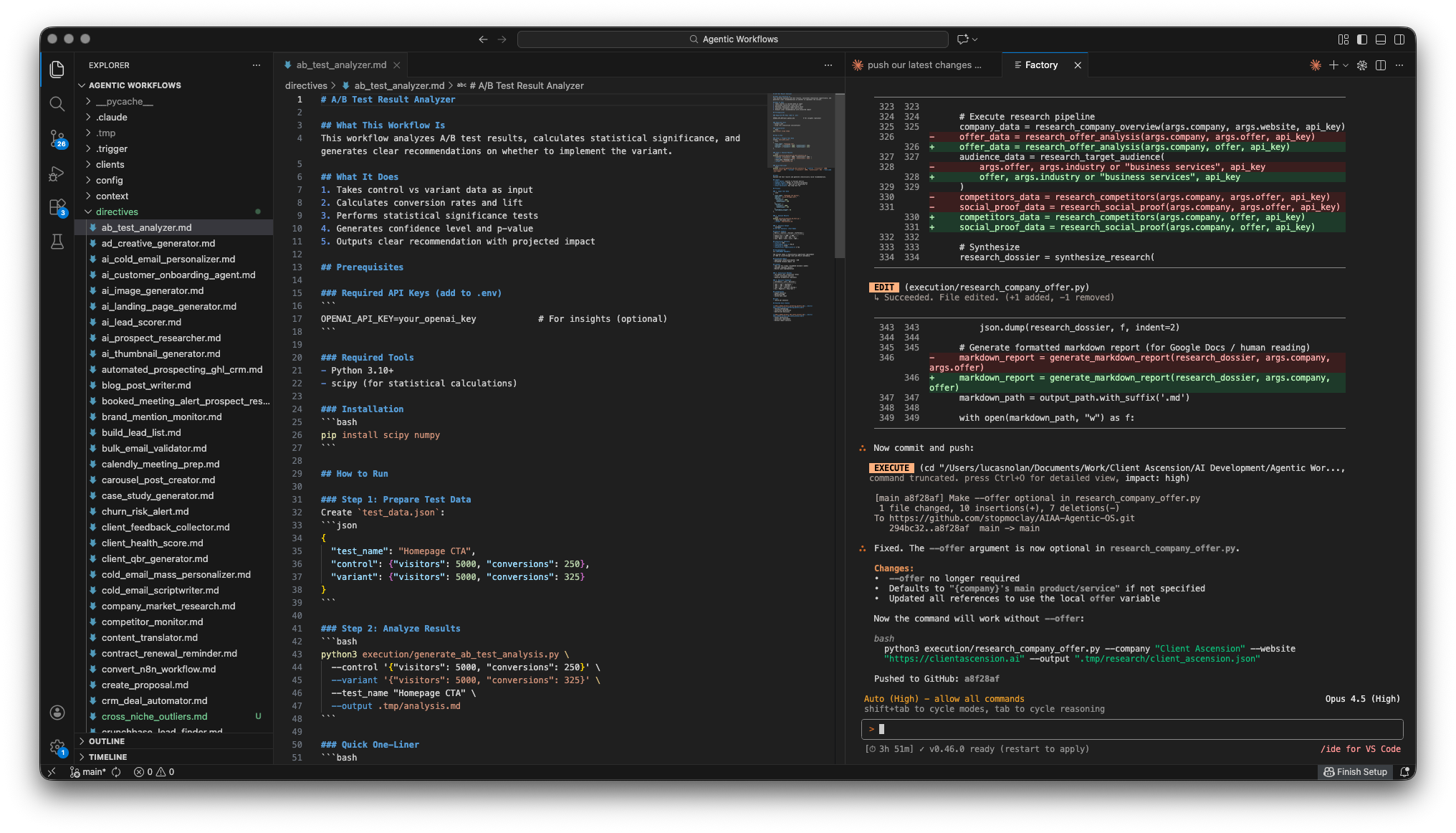
The choice matters less than understanding that you’re not programming logic anymore, you’re programming judgment.
The knowledge base stores context.
Client data.
Past interactions.
Outcomes from previous actions.
This is what lets the agent learn over time instead of treating every situation as new.
The directives explain the process you want to happen.
Not as code.
As detailed instructions written in natural language.
“When onboarding a new client, first verify their contract terms are complete. Then create their Slack channel using this naming convention. Then send the welcome sequence starting with...” and so on for thousands of words covering every scenario you’ve encountered.
You’re not teaching the machine to think.
You’re teaching it how you think about each specific domain.
Skill bibles explain how to perform complex tasks like write VSL’s, make landing pages, etc.
The initial setup requires actual work.
Writing comprehensive skill bibles takes time.
Documenting your processes at this level of detail surfaces all the implicit knowledge you’ve been carrying in your head.
But that’s where the value comes from.
The act of documenting forces clarity.
The skill bible becomes your operational playbook.
The agent is just the thing that executes it consistently.
Infrastructure costs stay surprisingly low because you’re not running specialized hardware.
Basic cloud instances handle the execution.
The language models providing the intelligence are API calls - you’re renting cognition, not building it.
Railway apps running 24/7 clock in around $4-10 monthly for basic setups.
LLM API costs scale with usage but typically land in the $200 range for agencies processing substantial workloads.
That’s per month, total, for systems handling dozens of clients.
Compare that to enterprise automation platforms charging $500+ monthly before you automate a single task, and the economics become clear.
What Changes When Systems Think
The second-order effects of agentic automation are more interesting than the direct benefits.
Your operational capacity stops being limited by your team size.
You can take on more clients without hiring more people.
That’s obvious.
What’s less obvious is how it changes what kind of work feels worth doing.
Before, you’d avoid clients with complex onboarding because the manual work wasn’t worth the contract value.
After, complexity becomes a feature instead of a bug.
The agent handles it the same way it handles simple cases - by following its directives and adapting to specifics.
You start competing on sophistication rather than efficiency.
The agency that can handle the most nuanced client situations wins, not the one that’s fastest at repetitive tasks.
This shifts the entire competitive landscape.
Traditional agencies get commoditized.
“We do the work” isn’t a value proposition anymore when autonomous agents do the work for $4 a month.
The agencies that win are the ones who understand their clients’ domains deeply enough to build skill bibles that capture real expertise.
You’re selling judgment, not labor.
There’s also something happening to how operators relate to their businesses when the systems run autonomously.
You’re not in the weeds anymore.
You’re not the person who knows where everything is and how everything works because you’re constantly touching it.
The system knows.
You become the person who decides what the system should learn next.
It’s a different kind of ownership.
More architectural, less operational.
Some people love it.
Others miss the hands-on control.
But you can’t ignore the math.
Autonomous systems scale in ways human systems don’t.
The question becomes what you do with that leverage.
The Access Problem
Building agentic workflows from scratch means solving a bunch of problems that have nothing to do with your actual business.
How do you structure the agent’s decision-making?
How do you handle memory and context?
How do you prevent the agent from going off the rails?
How do you monitor what it’s doing without babysitting it?
These are engineering problems.
Solvable, but time-consuming.
The kind of thing that takes months to get right if you’re figuring it out yourself.
Oliver and Doby spent hours building their systems from scratch.
The rest of our students won’t have to thanks to the AIAA Agentic OS.
Pre-built frameworks that handle the infrastructure layer.
One hundred twenty workflows already tested.
Two hundred fifty skill bibles covering common agency scenarios.
One prompt installation through GitHub that takes minutes instead of months.
This is how the technology actually reaches practitioners instead of staying theoretical.
Someone solves the hard infrastructure problems once.
Everyone else customizes the directives and skill bibles for their specific domain.
You’re not building an AI system.
You’re configuring one that already works.
The shift from builder to operator is what makes this accessible beyond technical founders.
You need to understand your business processes well enough to document them.
You need to know what outcomes matter.
You don’t need to know how neural networks function or how to optimize token usage.
The complexity gets abstracted.
You interact with directives and skill bibles written in plain language.
The system handles the rest.
What Happens Next
Two years from now, running an agency without agentic workflows will feel like running one without email feels today.
Technically possible.
Practically insane.
The agencies figuring this out now get a window where their operational capacity vastly exceeds their competition’s.
They can take on more clients, handle more complexity, deliver faster - all without scaling their team proportionally.
That window closes as the technology becomes standard.
Then it’s just table stakes.
But right now, there’s an asymmetry.
Most operators are still thinking in terms of traditional automation.
Zapier for simple stuff.
Custom code for complex stuff.
Both requiring constant maintenance.
The ones who understand that automation can maintain itself are building different businesses entirely.
They’re bottlenecked by how fast they can document their expertise, not by how many hours they can work.
That’s a better problem to have.
The shift from “I do the work” to “I teach the system to do the work” feels weird at first.
You’re not directly producing value anymore.
You’re producing the thing that produces value.
But that’s how leverage actually works.
You stop being the engine.
You become the person who builds better engines.
Oliver deleted his N8N workflows because he realized he’d built a beautiful prison.
The automation was elegant.
It was also brittle, demanding, and economically wrong.
He replaced it with something that fixes itself.
Something that improves over time instead of degrading.
Something that scales without his direct involvement.
The system runs 24/7 now.
He doesn’t.
That’s the actual promise of automation, finally delivered.