

Your Environment Is Why You're Inconsistent
You can't out-discipline a bad workspace

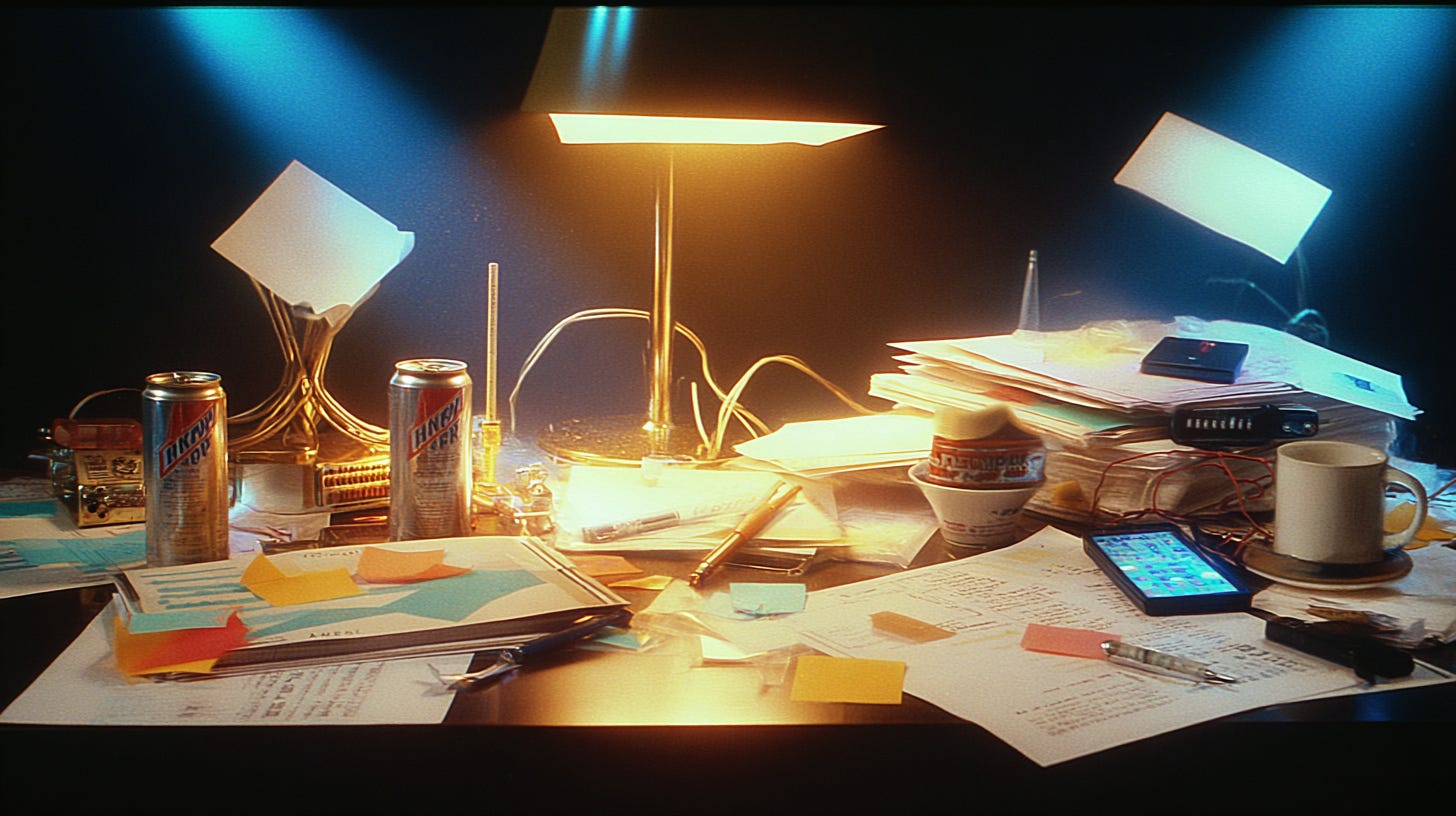
My desk was a mess.
Slack notifications firing off every thirty seconds.
Phone buzzing with texts, emails, DMs I didn't give a shit about.
Coffee cups stacked like some dystopian art installation.
Energy drinks lined up like soldiers.
I told myself I lacked discipline.
That I needed to try harder.
Be stronger.
More focused.
But the problem wasn't me.
The problem was everything around me.
You've probably been there too.
Sitting at your desk trying to focus while your environment actively fights against you.
Every ping, every notification, every piece of clutter is a tiny decision you have to make.
And every decision drains the tank.
Researchers have proven what you already know in your gut.
Your physical space directly impacts your ability to think, focus, and perform.
Studies show that workspace organization, lighting, noise levels, and even air quality measurably affect productivity and cognitive performance.
One study found that simply adding plants to an office improved work efficiency by 3.4%.
Not because plants are magic, but because the environment stopped working against people.
Your environment creates you as much as you create it.
The Friction Audit
Most people think about building habits.
They don't think about removing obstacles.
That's backwards.
Before you add anything:
A new routine
A productivity system
A morning ritual
You need to subtract the things making focus impossible.
I started by tracking every single interruption for one day.
Every notification.
Every time I picked up my phone.
Every moment someone slacked me.
Every instance of background noise pulling my attention.
The number was obscene.
Over 200 interruptions in an eight-hour workday.
That's one interruption every 2.4 minutes.
No wonder I couldn't think straight.
Here's what I found when I actually paid attention:
Phone notifications: 47 times
Slack messages: 62 times
Email checks (compulsive, not necessary): 31 times
Random internet rabbit holes: 18 times
People interrupting physically: 12 times
Background noise breaking concentration: 41 times
Each interruption seems small.
Harmless.
But research on task-switching shows that every time your attention shifts, you pay a cognitive penalty.
Your brain doesn't just pause.
It has to rebuild context when you return.
That rebuilding costs time and mental energy.
The friction audit isn't about judgment.
It's about awareness.
You can't fix what you don't see.
Write down everything that breaks your focus for one full day.
Don't filter it.
Don't minimize it.
Just observe.
Then ask:
What percentage of these interruptions actually matter?
For me, it was about 8%.
The rest was noise dressed up as productivity.
Engineering For Inevitability
Once you see the friction, you can design against it.
This is where most advice gets soft.
People tell you to "minimize distractions" or "create a productive space" without telling you how.
So here's how.
I deleted Slack from my phone.
Completely.
If someone needs me urgently, they have my number.
In two years, that's happened three times.
I turned off every notification except phone calls from five people.
Everything else can wait.
I put my phone in a drawer across the room.
Sounds stupid.
Works perfectly.
The physical distance creates just enough resistance that I don't check it compulsively.
I cleaned my desk completely.
One notebook. One pen. My monitors.
Everything else went into a drawer or the trash.
When there's nothing to look at except the work, the work gets done.
I started using website blockers during deep work sessions.
Not because I lack willpower.
But because willpower is a finite resource and I'd rather spend it on something that matters.
Research backs this up.
Studies on environmental design consistently show that people perform better when their environment supports their intended behavior automatically.
Natural light improves alertness.
Controlled noise levels enhance focus.
The ability to personalize your workspace increases both satisfaction and output.
You're not trying to become more disciplined.
You're trying to make good behavior the path of least resistance.
When I sit down at my desk now, there's nothing to do except work.
The friction is gone.
The decision is made before I even sit down.
That's what engineering for inevitability means.
You remove the question "should I focus?" by removing every easy alternative.
The Subtraction Principle
Everyone wants to add something.
A new app.
A new system.
A new morning routine.
Deletion is more powerful than addition.
I used to have seven different productivity apps.
Task managers, note-taking systems, calendar tools, focus timers.
Each one promised to make me more productive.
Each one became another thing to manage.
I deleted all of them except two.
Apple Notes for my to-do list.
A calendar.
That's it.
The mental space I got back was immediate.
Most people try to add motivation when they should subtract distractions.
They buy courses on discipline when they should delete Instagram.
They read books about focus while keeping Slack open in the background.
Your brain has limited bandwidth.
Every app, every open tab, every piece of clutter takes up space.
When you clear the space, the bandwidth returns.
Here's what I deleted:
Social media apps from my phone (checked once a day on desktop)
Email from my phone (checked twice a day on desktop)
Every browser extension except three essential ones
90% of the shit on my desk
Half the furniture in my office
Group chats that were just noise
Each deletion felt like removing a weight I didn't know I was carrying.
The space you create by removing becomes the space where focus lives.
The Immediate Actions
You don't need a complete overhaul.
You need three changes today.
Clean your desk.
Completely.
Everything off.
Then put back only what you actually use daily.
The rest goes in a drawer or the trash.
This takes fifteen minutes and changes everything.
Turn off notifications.
All of them.
Not on silent - off.
If someone needs you, they'll find you.
They always do.
This takes three minutes and saves you hours.
Identify your biggest source of digital friction.
The app you compulsively check.
The website you fall into.
The platform that eats your time.
Delete it from your phone.
Block it during work hours.
Remove the option.
This takes two minutes and returns your attention.
These aren't dramatic changes.
They're subtractions.
You're not adding discipline - you're removing the things that make discipline necessary.
Your environment should make focus automatic, not heroic.
The Truth You Already Know
"Clean desk, clean mind" isn't some Instagram caption bullshit.
It's how your brain actually works.
Your physical and digital environment constantly signals what you should pay attention to.
When everything screams for attention, nothing gets it.
When your space is clean, your priorities clear, your distractions deleted, focus becomes the default state.
You can't out-discipline a bad environment.
You'll lose that fight every time.
But you can build an environment where the right behaviors happen automatically.
Start with your desk.
Clear everything.
Then look at your phone.
Delete the apps stealing your time.
Then audit your digital workspace.
Close the tabs.
Silence the notifications.
Remove the friction.
The consistency you're chasing doesn't come from trying harder.
It comes from making the trying unnecessary.
Clean your desk. Clean your life. It's that simple.